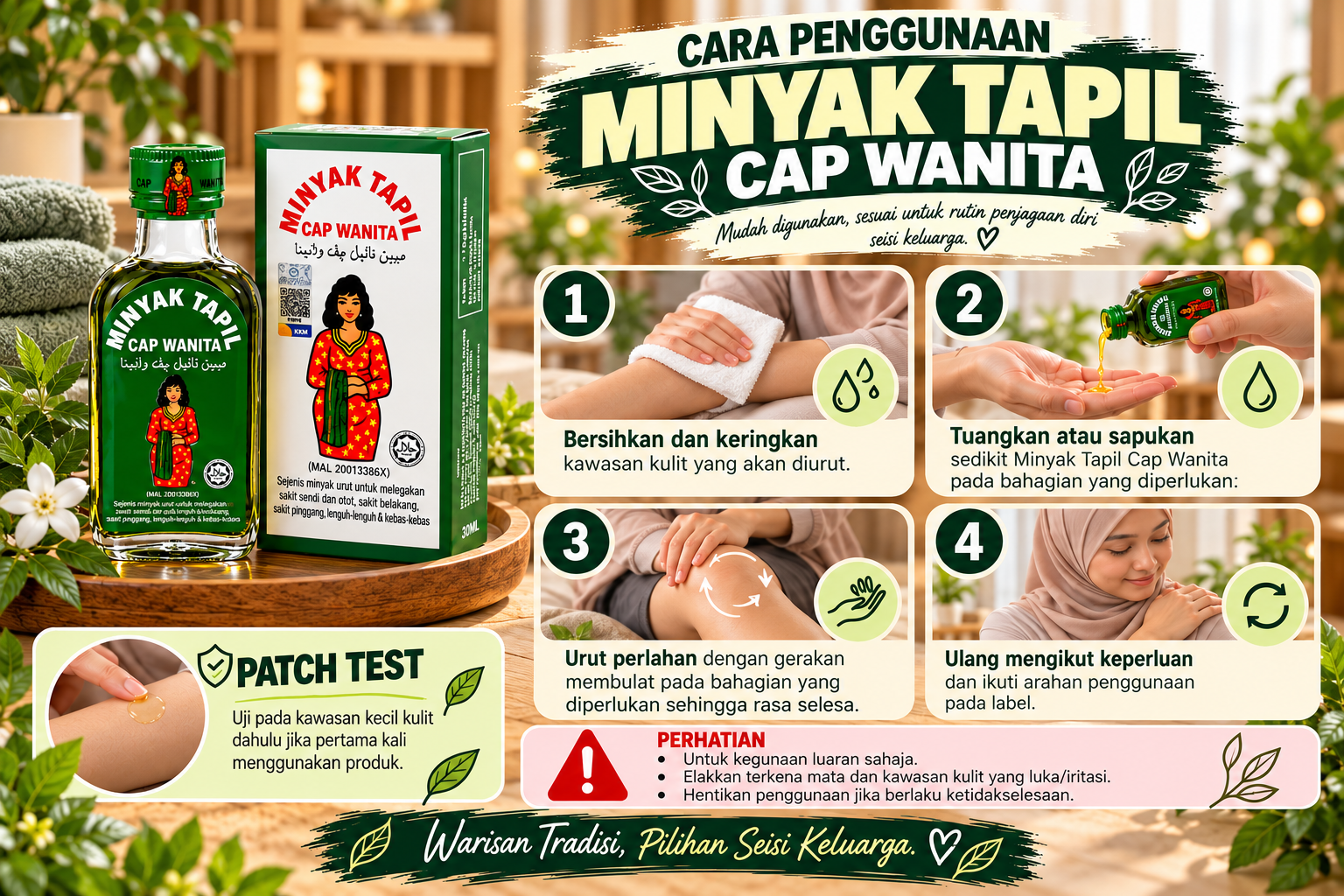
Minyak Tapil Cap Wanita Usage
How to Use Minyak Tapil 1️⃣ Clean the skin – Ensure the area is clean and dry. 2️⃣ Apply a small amount – Use on the desired area. 3️⃣ Massage gently – Massage...

Camphor is an aromatic ingredient in some topical products that may produce a cooling or warming sensation. Use only labelled, ready-made products, avoiding broken skin, eyes, excessive application, and homemade mixtures. Camphor must not be swallowed as it can cause serious poisoning, especially in children. Store safely and discontinue use if irritation occurs.
Camphor is a strongly aromatic compound used in certain topical and fragranced products. In everyday language, it is sometimes associated with the term “mothballs,” but commercially available products may have very different purposes and compositions. Consumers should rely on the product label rather than the general name alone.
Products intended for wardrobes, room fragrance, and topical application must not be used interchangeably because their additives and levels of exposure may differ.
In topical formulations, camphor may produce sensations described as cooling, warming, or slightly tingling. These effects depend on its concentration, the other ingredients, and the user’s sensitivity. As with menthol, the sensation does not indicate that an illness has been treated or an injury has healed.
The skin has various sensory systems that respond to temperature and certain chemicals. Camphor may influence sensory signals, while the evaporation of ingredients in the formulation and air movement can also alter how the skin’s surface feels. When combined with menthol or other aromatic ingredients, the sensory effect may become more complex.
Terms such as “hot” and “cold” on product labels often describe perception rather than precise changes in temperature. Do not use these sensations to assess the severity of an injury. If the affected area remains swollen, extremely painful, or difficult to move, seek an appropriate medical assessment.
The most important warning is that camphor must not be swallowed. Oral exposure can cause serious poisoning, particularly in children. Keep the product tightly closed in its original container and store it away from food, drinks, and children’s reach. Do not transfer it into an unlabelled bottle.
If camphor is swallowed or ingestion is suspected, do not wait for symptoms to appear. Immediately contact emergency services or your local poison centre and provide the product information. Avoid unverified home remedies.
Use camphor only in products formulated for their intended purpose. Do not apply it to broken skin, rashes, mucous membranes, or areas near the eyes. Wash your hands after use. Avoid heating pads, tight bandages, or excessive application, as these may increase exposure and irritation.
Some individuals may experience redness, itching, or dermatitis. Discontinue use if the sensation becomes painful or burning, the skin blisters, the face swells, or breathing becomes difficult. Serious reactions require immediate medical attention.
Mixing camphor crystals, essential oils, or several topical products at home may result in an unknown concentration. It also increases the risk of improper storage or accidental ingestion. Use only one labelled product at a time and follow the stated frequency of application.
If camphor is an ingredient in Minyak Tapil Cap Wanita, its role should be described as contributing to the formulation’s overall aroma and sensory effect. Apply the oil externally according to the label, using the recommended amount on unbroken skin. Careful use is more important than seeking an intense warming or cooling sensation.
Jimmy
Updated
Information on this site is for general information only and is not a substitute for professional medical advice. Consult a qualified healthcare practitioner for any health condition.
How to Use Minyak Tapil 1️⃣ Clean the skin – Ensure the area is clean and dry. 2️⃣ Apply a small amount – Use on the desired area. 3️⃣ Massage gently – Massage...
Key points to understand A gentle shoulder routine can support relaxation, but it does not correct an undiagnosed neck or nerve problem. Work posture, screen he...
Key points to understand Carrier oils provide the base for application, while some finished products contain aromatic ingredients or ingredients that create coo...
Install App